
AI
I Think AI Is Just Another Machine
From machine learning classes to ChatGPT, vibe coding, and Raspberry Pi—somewhere along the way I stopped seeing AI as the point.
Reading preferencesAdjust the page or listen to the article
Uses the best English voice available on this device.
I’ve been playing with AI again lately.
Not because there’s suddenly one new model I really care about. I think I already passed that phase where I felt like I needed to try every new AI thing that appeared on my timeline.
It’s more that, after using AI pretty casually for a while, it somehow became fun again.
My first exposure to AI wasn’t ChatGPT anyway.
Back in university, I learned about machine learning through an application development course. Nothing deep enough to turn me into a machine learning engineer, obviously, but at least it gave me some idea of what was happening underneath. Models, data, training, predictions. AI stopped looking like magic.
Then I got interested in IoT and started hearing about AIoT—the point where AI meets sensors, devices, automation, and connected things.
I found it interesting, but AI still felt like something I studied or read about.
Not something I would casually talk to every day.
Then ChatGPT happened.
I started using it around the early generative AI boom in 2022. At least among the people around me, not many were using it seriously yet, let alone paying for it.
At first I mostly asked questions.
Then I started using it to write things.
Then PRDs.
CVs.
Product brainstorming.
Random discussions.
Sometimes even venting when I just needed somewhere to dump thoughts without bothering another human being.
Eventually I was using AI for posters, image editing, writing, product work, and whatever random problem happened to be in front of me.
And then, at some point, I got tired of AI.
I stopped trying to keep up
There was always something new.
A new model.
A new tool.
A new prompting technique.
A new startup explaining why the tool from three weeks ago was apparently obsolete now.
Eventually I just stopped caring.
I still used ChatGPT and other AI tools, but they became normal utilities. Open it when I need something, close it when I’m done.
Nothing particularly exciting.
A few months ago I somehow started exploring again.
First it was generating mockups and UI ideas.
Then vibe coding with Codex.
Then building small web apps and prototypes without spending most of the time worrying about setup and syntax.
This website you’re reading is part of that.
And somehow AI also got me interested in IoT again. I started playing with Raspberry Pi projects, sensors, cameras, small automations, and ideas I probably would’ve left sitting in a notes app before.
Which is kind of funny.
IoT was one of the reasons I became interested in AI years ago, and now AI is making me interested in IoT again.
After going through that loop, one thought keeps coming back:
I think AI is just another machine.
Maybe “AI makes us lazy” is the wrong question
One argument I hear a lot is that using AI will make people lazy.
We’ll stop thinking.
We’ll forget how to write.
We’ll stop learning.
Our brains will slowly turn into mashed potatoes while ChatGPT does everything for us.
And… maybe?
I don’t think that concern is completely wrong.
I just think it starts with the wrong question.
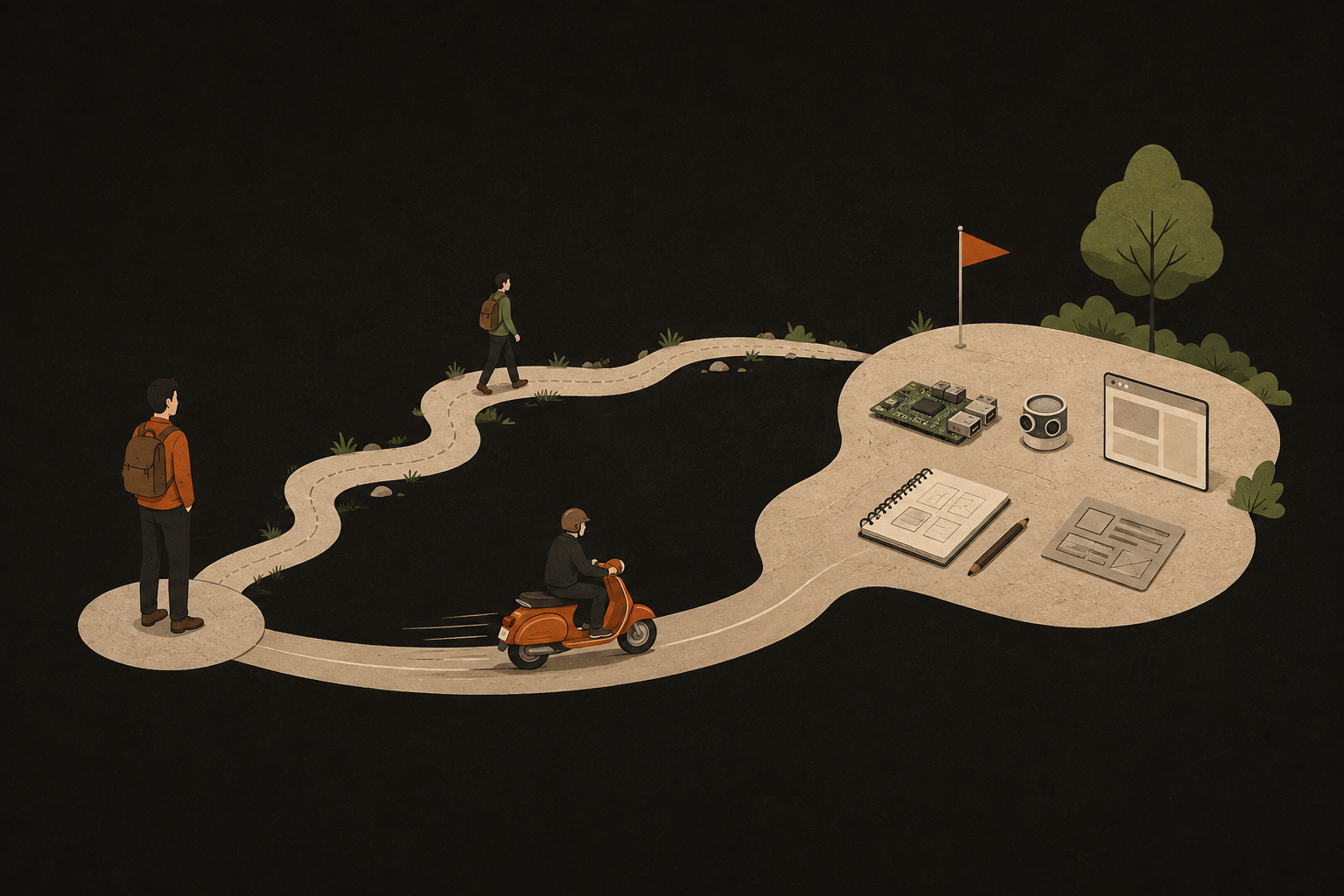
If my objective is to get from point A to point B, taking a motorcycle is obviously more efficient than walking.
But if my objective is to train my legs, then taking the motorcycle completely defeats the purpose.
Same motorcycle.
Different objective.
That’s basically how I think about AI now.
If I’m learning programming because I actually want to understand how an algorithm works, asking AI to generate everything and blindly copy-pasting the result is probably a terrible way to learn.
I’m optimizing for understanding.
But if I already have a product idea and I just need a rough prototype to see whether the interaction makes sense, spending two days manually writing something AI can help me build in thirty minutes doesn’t automatically make the result more valuable.
I’m optimizing for learning whether the idea works.
A calculator isn’t cheating unless the point of the exercise is doing the calculation yourself.
A motorcycle isn’t cheating unless the point is walking.
AI isn’t that different.
Which also means I don’t think “use AI for everything” is particularly smart either.
Sometimes the friction is the point.
Sometimes I need to struggle with a problem because that’s how I understand it.
Sometimes I need to read the documentation instead of getting a summary.
And sometimes the decision involves customers, money, systems, or people, so “the AI said so” obviously isn’t an acceptable reason.
Delegating execution is useful.
Delegating judgment without understanding what you’re doing is something else entirely.
The interesting part is what becomes possible afterward
There’s also a less philosophical reality here.
Most of us work with constraints.
Time.
Budget.
Deadlines.
Output.
We can argue about whether modern work is too obsessed with productivity, and I probably wouldn’t disagree.
But the ticket still says Friday.
If AI can get a first draft done in twenty minutes instead of two hours, I’ll probably use the twenty-minute version and spend the remaining time thinking about whether the thing makes sense in the first place.
That’s what changed the most for me.
Not “10x productivity.”
Not replacing an entire engineering team from my bedroom.
Nothing that dramatic.
AI mostly made curiosity cheaper.
Before, I could have an idea for a Raspberry Pi project and immediately start thinking about everything required before I could even test it.
Which library do I need?
How do I connect this thing?
What’s the API supposed to look like?
Why is this dependency broken?
Do I really want to spend my Saturday debugging this?
And suddenly the idea stays in Notes for six months.
Now I can have the same random thought at night and sometimes have an ugly but working version before I go to sleep.
Same thing with websites.
Small apps.
Automations.
UI ideas.
Scripts.
Most of them won’t become real products.
Some of them probably shouldn’t.
But I can find that out much faster now.
The distance between:
“I wonder if this would work.”
and
“Oh. So that’s what happens when I actually build it.”
has become much shorter.
That’s probably the part of AI I’m most interested in right now.
Not AI itself.
What becomes easier to explore because it’s there.
I don’t feel like AI made me stop thinking.
If anything, it changed which layer I spend my time thinking about.
Less time worrying about how to get the first version onto the screen.
More time asking whether the idea is useful.
Whether the trade-off makes sense.
What should happen next.
What shouldn’t be built at all.
I still need to know how to walk.
I just don’t think I need to walk everywhere to prove that I can.