
2024 - Present
JD Sports Indonesia Mobile App
Many people assume the hardest part of building a mobile app is the development itself. In my experience, the more difficult challenge came afterwards—making product decisions when every stakeholder brought a different perspective, and each of them had a valid reason. This project became my real lesson in building a product not only for users, but alongside people with different priorities and expectations.
MY CONTRIBUTION
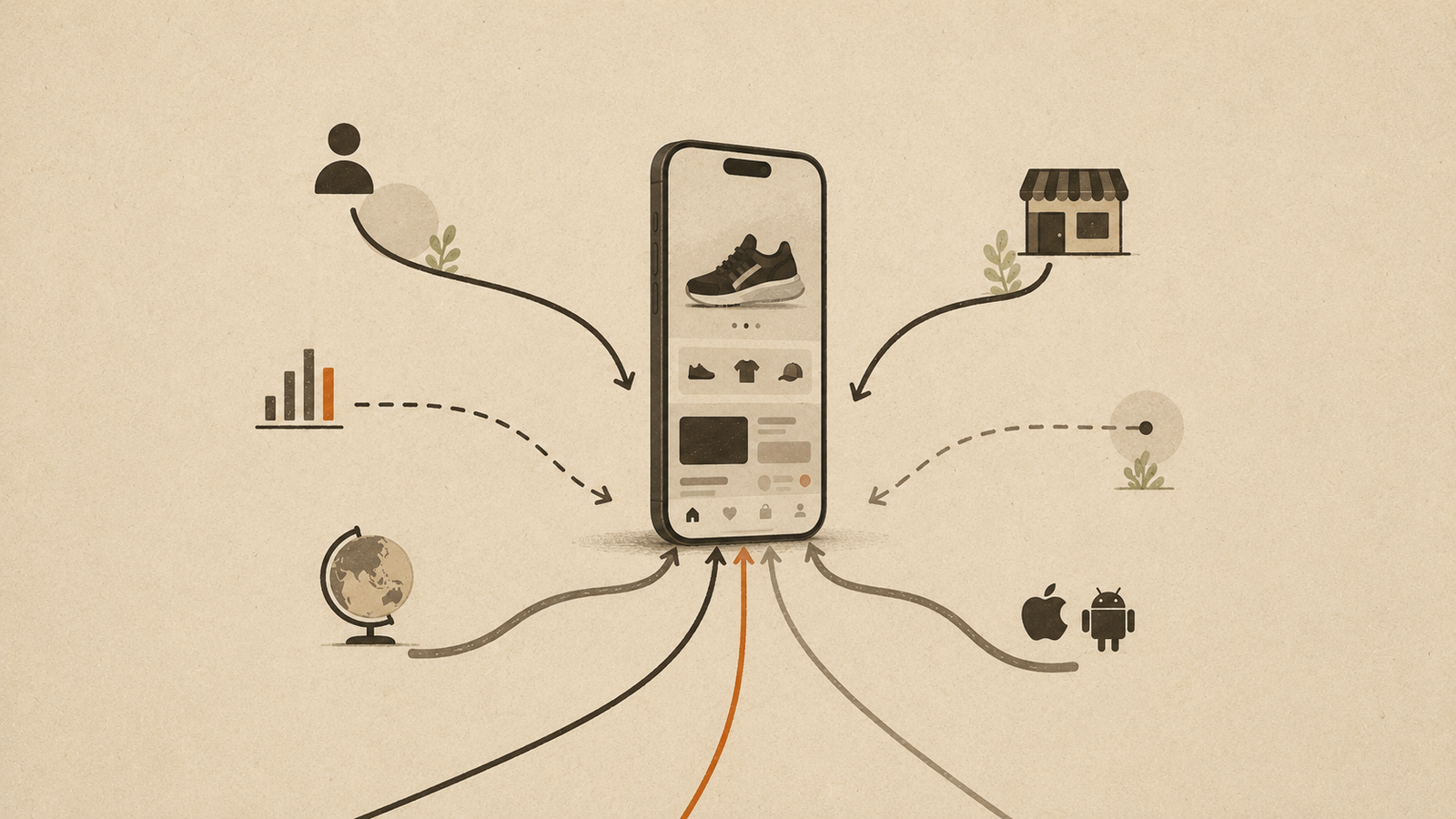
I have been the Product Manager for the JD Sports Indonesia mobile app from its initial development through its ongoing evolution today. The role sounds simple when described, but in practice it meant sitting between Android and iOS engineers, designers, researchers, local business teams, regional stakeholders, and global stakeholders. A large part of my work was not simply writing requirements or deciding what feature should come next. Much of it involved understanding why a request existed, identifying the actual problem behind it, and helping the different teams reach a decision that still made sense for customers, the business, and the people who had to deliver it. I worked across prioritization, roadmap planning, discovery, and delivery, but the decisions were rarely made by one person alone. My role was mostly to make sure the discussion had enough context, the trade-offs were visible, and the team understood why we were choosing one direction over another.
PROBLEM
When the project started, JD Sports Indonesia did not yet have its own mobile app. We were not improving an existing product or adding a few new features. We were starting from zero. At first, I expected the hardest part to be the development itself: defining the initial scope, building for both Android and iOS, and getting everything ready for launch. It turned out that decision-making was much harder. The product involved people with very different perspectives. Local teams were closer to Indonesian customers. Regional stakeholders brought experience from other APAC markets. Global teams had standards and product direction they wanted to keep consistent. At the same time, day-to-day operational realities were not always visible from a regional or global perspective. The challenge was rarely that one side was clearly right and another was wrong. Most of the time, everyone had a reasonable argument. They were simply looking at the problem from different contexts.
APPROACH
We eventually stopped treating the app as a project that would be finished once it reached the App Store and Google Play. The first release mattered, but I saw it more as a foundation. From there, the product needed to keep learning from customers, changing business needs, and things that only became visible once people were actually using it. One habit that helped was not jumping directly into solutions whenever a new request came in. I would usually step back and ask: what problem are we actually trying to solve? That simple question often changed the conversation. Sometimes two stakeholders appeared to disagree when they were actually proposing different solutions to the same problem. Sometimes a request sounded urgent, but once the context became clearer, it did not need to be built immediately. And sometimes the global approach was perfectly reasonable, with no good reason to make something different just because the market was Indonesia. So the goal was never to always choose local or always follow global. Decisions were made case by case, considering customer context, business needs, effort, downstream consequences, and whether the decision would still make sense months after release. That same approach has continued through regular product iterations and development sprints since launch.
OUTCOME
The app launched on both Android and iOS and continues to be developed today. Since launch, it has passed 500,000 downloads across both platforms while maintaining an organic rating of 4.8+ on the App Store and Google Play. More importantly to me, the app did not stop being a launch project. It continues to support daily customer transactions and receives regular improvements through ongoing development sprints. In Indonesia, JD Sports was also among the earlier sports retailers to seriously invest in a dedicated mobile app while many other players were still primarily relying on the web as their main digital channel.
IMPACT
From the outside, the outcome of this project might sound simple: the app was built, launched, and eventually used by a large number of customers. For me, the bigger impact was how it changed the way I work afterwards. I became much more skeptical of statements like “users need this,” “this is how another market does it,” or “the business wants this” without first understanding the context behind them. Any of those statements can be valid, but none of them automatically makes something the right product decision. I also learned that a Product Manager does not always need to be the person with the best answer in the room. Often, the more useful job is making sure everyone in the room is actually discussing the same problem. That is probably the biggest lesson I took from this project: building products is not only about making good decisions. A lot of the work is about finding decisions that are reasonable enough for people with different interests to keep moving in the same direction.
PROJECT GALLERY
Project gallery
Product views and supporting details from this project.
LET'S TALK
Something worth talking about?
Product, systems, something you're building, or just an idea worth comparing notes on—feel free to reach out.