
2021
IoT Solution Prototyping
Before moving into Product Management, I spent several months working much closer to the technology itself.
I joined Gamatechno as an IoT Engineer, although the actual role quickly became closer to an IoT System Analyst. I worked with prospective clients to translate operational problems into technical concepts, then built prototypes to find out whether those concepts could actually work.
Some worked technically.
None became production deployments during my time there.
That turned out to be one of the most useful parts of the experience.
MY CONTRIBUTION
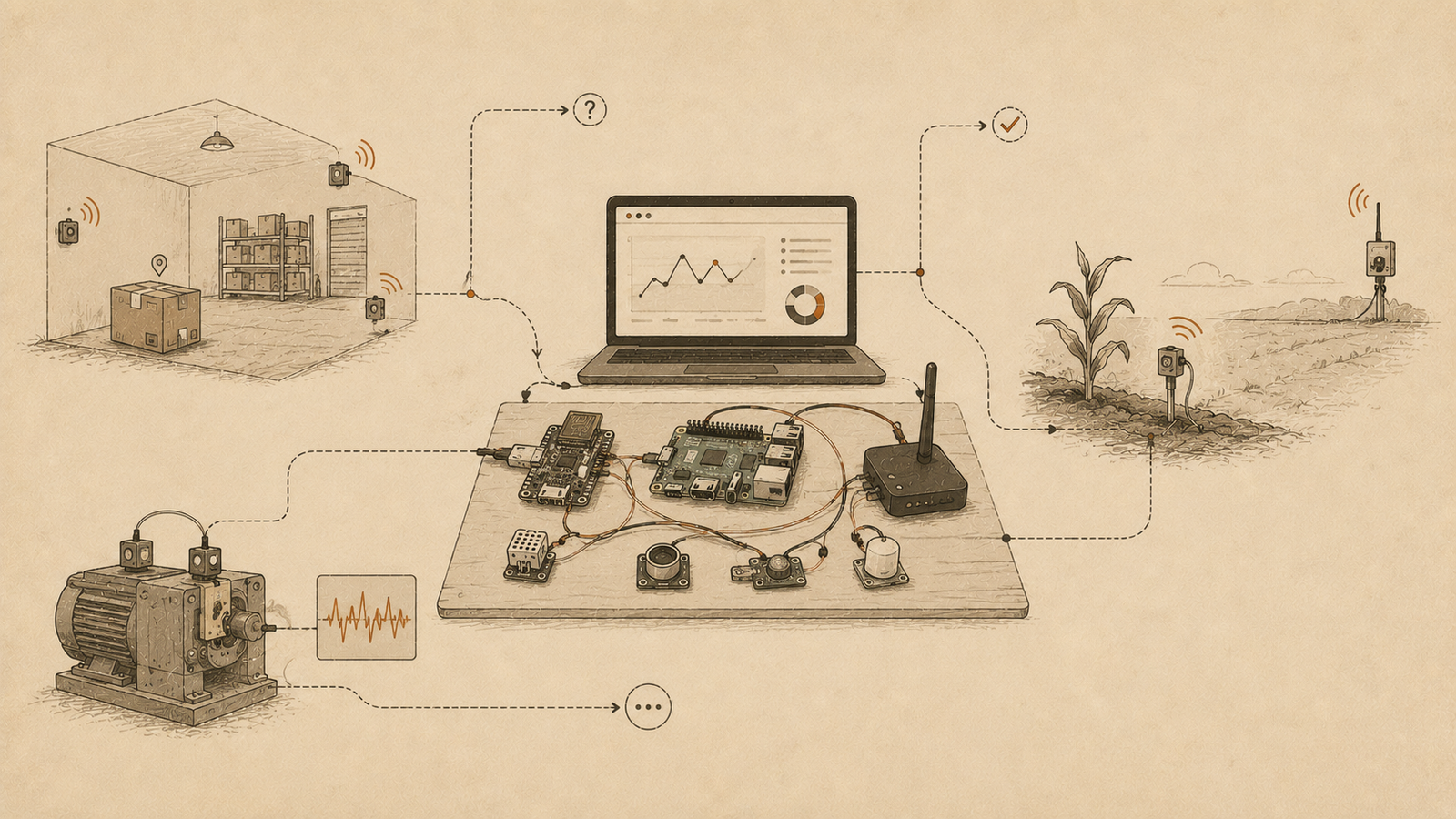
My work usually started before there was a product. A client would come with an operational problem or an idea around IoT, and my role was to help turn that into something concrete enough to evaluate. I worked on prototypes across several problem spaces, including indoor asset tracking using Bluetooth signals, environmental monitoring for agriculture, and machine monitoring for industrial maintenance. Because these were early prototypes, the boundaries between roles were unusually loose. I worked across hardware, sensors, connectivity, data processing, cloud services, and enough of the application layer to demonstrate the complete concept before handing more mature application work to dedicated engineers. It was probably the closest I’ve ever been to being “full-stack”—if the stack starts at a physical sensor and ends somewhere in a browser.
PROBLEM
IoT was often introduced as the solution before the problem had been fully understood. “Can we track this?” “Can we monitor that?” “Can this machine tell us when something is wrong?” Technically, the answer was surprisingly often yes. But proving that something could be built was only the first question. The harder questions appeared afterwards: How reliable does it need to be? How much infrastructure needs to be installed? Who maintains the devices? How does connectivity behave in the actual environment? And ultimately, does solving this problem justify what the complete system would cost? A prototype could answer feasibility. It couldn’t automatically answer viability.
OUTCOME
The prototypes demonstrated several IoT concepts across logistics, agriculture, and industrial monitoring, but none progressed into full production deployment during my time at Gamatechno. I don’t consider that something the case study needs to hide. The prototypes did what prototypes are supposed to do: turn assumptions into something observable, expose the practical constraints behind an idea, and provide better information before significantly more money and engineering effort were committed. Some ideas survived the technical test. The business case was harder.
IMPACT
This period gave me technical depth that became unexpectedly useful after I moved into Product Management. Working from physical sensors through connectivity, data processing, and application interfaces made systems feel less abstract. It taught me to trace information across boundaries and to understand enough of each layer to have better conversations with specialists later in my career. But the more important lesson wasn’t technical. It was learning that building something is itself a cost, and sometimes the most valuable result of building a prototype is deciding not to build the full product.
LET'S TALK
Something worth talking about?
Product, systems, something you're building, or just an idea worth comparing notes on—feel free to reach out.