
2021
End-to-end Smart Water Meter Platform
What started as an IoT device became a much bigger product problem.
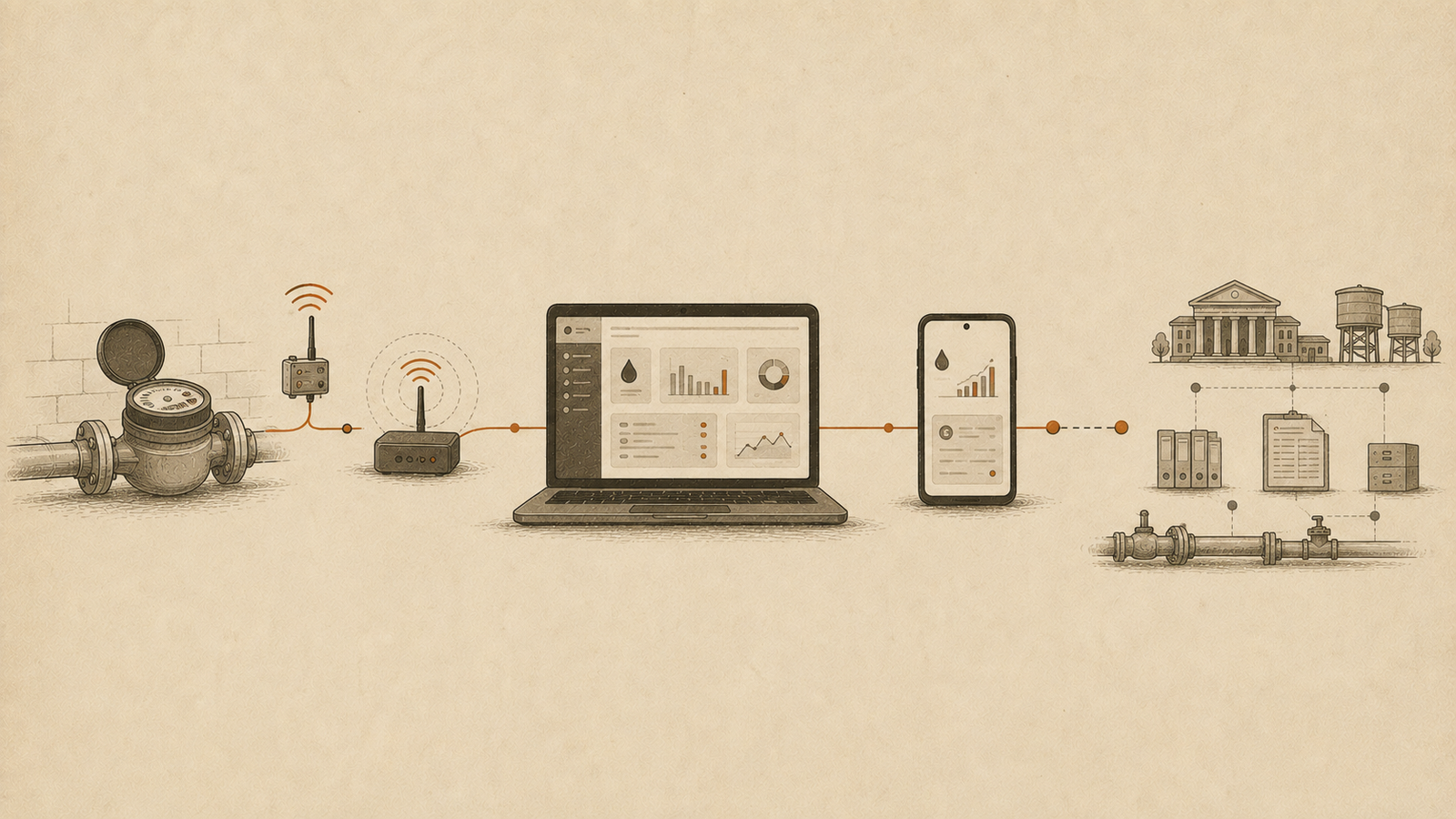
At Gamatechno, I was trusted to take Product Owner responsibility for an end-to-end smart water metering platform aimed at regional water utilities in Indonesia. The product connected physical meters, IoT connectivity, operational software, and customer-facing mobile apps into one service.
We built it. We demonstrated it to prospective users.
But during my time there, we never reached commercial adoption.
That experience taught me something I couldn’t have learned from technical prototypes alone: having a working and relatively complete product still doesn’t mean the market is ready to buy it.
MY CONTRIBUTION
My role sat somewhere between Product Owner and IoT System Analyst. I worked across the complete product concept: from how metering data could be collected and transmitted, through the IoT platform, into an operational application used by water utilities, and eventually into mobile experiences for their customers. The operational side wasn’t only about displaying meter readings. The product explored how utilities could manage customers, consumption, billing, and different payment models through the same platform. On the customer side, Android and iOS applications provided access to account and billing-related experiences. I worked with engineers and other specialists to turn these pieces into one coherent product while also participating in demonstrations and discussions with prospective users.
PROBLEM
Traditional water metering creates a deceptively simple problem. A meter records consumption, but that information still needs to reach the organization responsible for managing the service. From there, it needs to become operational information, billing, and eventually something understandable to the customer. Connecting the meter to the internet only solved the first part. The larger challenge was turning that connectivity into a system that could actually fit how regional water utilities operated. And unlike a consumer product where a user can simply download an app and try it, adopting this product required an organization to commit to hardware, infrastructure, operational change, and a different way of managing part of its business. The technical product could be built faster than the market could necessarily adopt it.
OUTCOME
We developed an end-to-end smart water metering concept connecting physical meters, IoT connectivity, an operational platform, and customer-facing mobile applications. The product reached a stage where it could be demonstrated to prospective regional water utilities in several locations. However, during my time at Gamatechno, those discussions did not turn into commercial adoption. Rather than treating that as a missing ending, I see it as part of the product story. We had proven that the system could work. What remained unproven was whether the value proposition, adoption cost, organizational readiness, and market conditions aligned strongly enough for customers to change how they operated.
IMPACT
This was probably my first experience owning something that looked much more like a complete product than a prototype. That distinction taught me an uncomfortable but important lesson. You can have working hardware. You can have connectivity. You can have an operational platform. You can have mobile apps. You can demonstrate the entire thing successfully. And still not have a business. That experience stayed with me when I later moved into Product Management. I became much more skeptical of using product completeness as evidence that a product was valuable.
PROJECT GALLERY
Project gallery
Product views and supporting details from this project.
LET'S TALK
Something worth talking about?
Product, systems, something you're building, or just an idea worth comparing notes on—feel free to reach out.